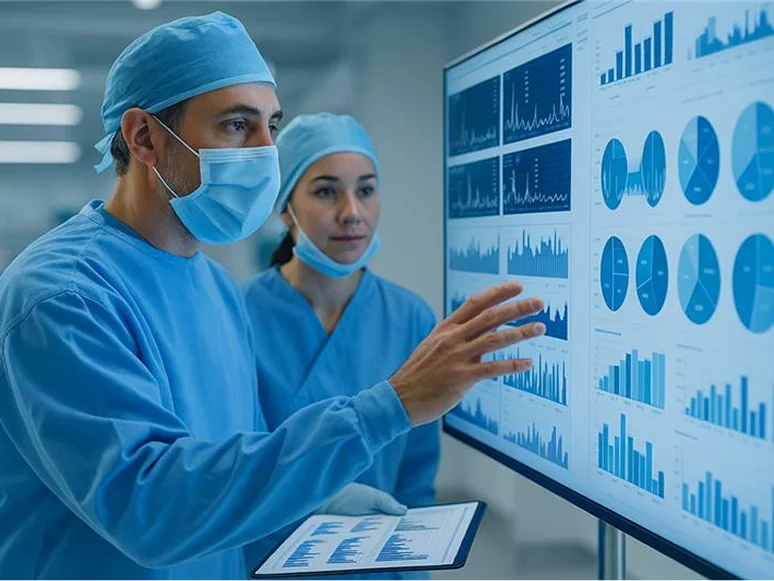

FROM HOSPITAL INSIGHTS TO BOARDROOM DECISIONS
MIRAI - Healthcare Performance Intelligence for Leadership
The only platform that connects strategy, performance, and risk into a single executive decision system for hospitals.
MIRAI is not another dashboard. It is a healthcare performance intelligence platform designed as a leadership infrastructure. It enables hospital leadership to move from fragmented reporting to structured, real-time decision-making - with actionable strategies that drive improvement on the ground.


Why Healthcare Organizations Need MIRAI
Most hospitals manage complex, multi-specialty institutions using disconnected systems - an HIS for Billing, EMR for clinical data, ERP for financial reporting, and manual processes for strategy review. This creates a dangerous illusion of control.
The reality is stark:
MIRAI provides the unified intelligence layer that bridges this gap - bringing clarity, control, and structured decision-making to hospital leadership.
The MIRAI Framework: Six Dimensions of Hospital Performance
Built on the Balanced Scorecard methodology, MIRAI organizes hospital performance into six interconnected dimensions — ensuring that financial results, patient outcomes, operational efficiency, workforce growth, risk management, and sustainability are never viewed in isolation.
Financial Performance
Track ARPOB (Average Revenue Per Occupied Bed), EBITDA margins, revenue per department, cost-to-revenue ratios, and surplus trends. Link every financial outcome to the strategic initiative that drives it. Identify revenue leakage before it compounds.

Patient Experience
Monitor patient satisfaction scores, Net Promoter Score (NPS), complaint resolution TAT, readmission rates, and patient feedback sentiment. Align experience metrics to strategic goals — because patient loyalty drives long-term revenue.

Operational Efficiency
Track OPD throughput, IPD bed occupancy, Average Length of Stay (ALOS), OT utilization, ER door-to-doctor time, Lab TAT, Radiology TAT, and pharmacy dispensing time. Identify bottlenecks in real-time, not in retrospective reports.

Learning & Growth
Use following KPIs: Employee Engagement Score, Employee Satisfaction Score, Voluntary Attrition Rate, Training Hours per Employee, Mandatory Training Completion Rate, Digital Competency Score, Leadership Development Participation Rate, EMR Utilisation Rate, etc.

Enterprise Risk Management
Connect clinical risks (HAI rates, medication errors, surgical complications) and operational risks (equipment downtime, supply chain disruptions) to financial exposure. Quantify risk in currency, not just percentages.

ESG & Compliance
Track EWS (Economically Weaker Section) bed allocation compliance, energy consumption and solar ROI, waste management metrics, and regulatory audit readiness (JCI/NABH). Governance is not optional — it is a competitive advantage.
Beyond Dashboards. MIRAI Drives Action.
The 4-Pillar Strategy Execution Module.
Most hospital dashboards stop at showing you a red number. MIRAI goes further. When a KPI underperforms - whether it is OPD patient wait time, Lab TAT, or bed occupancy - MIRAI does not just alert you. It deploys a structured, evidence-based strategy to fix it.
Every KPI in MIRAI is backed by a weighted action plan organized across four pillars. Each task is assigned an owner, a weightage, and a measurable outcome. This is not a suggestion engine - it is a strategy execution system.
People
25-30% Weightage
Staffing optimization, skill-based task assignment, consultant performance alignment, training programs, and cross-functional team deployment.
Example: If Lab TAT is breaching targets, MIRAI identifies whether the root cause is understaffing during peak hours and recommends shift rebalancing with specific FTE targets.
Process
30-35% Weightage
Workflow redesign, SOP enforcement, TAT reduction protocols, escalation matrices, and Lean/Six Sigma-based process improvements.
Example: If OPD wait time exceeds 15 minutes, MIRAI triggers a process review from registration bottlenecks to consultation scheduling gaps with specific corrective actions.
Technology
25-30% Weightage
HIS/EMR integration optimization, automation of manual workflows, digital patient engagement, AI-driven predictive alerts, and real-time data pipeline improvements.
Example: If Radiology report TAT is high, MIRAI recommends PACS workflow automation and AI-assisted preliminary reads.
Infrastructure
10-20% Weightage
Facility upgrades, equipment utilization optimization, spatial redesign, signage improvements, and capacity expansion planning.
Example: If ER overcrowding is a recurring issue, MIRAI recommends triage zone expansion, dedicated fast-track bays, and ambulance bay redesign with specific cost-benefit analysis.
Worked Example for the Web Page:
KPI: Lab Sample Rejection Rate (Target: <2%, Actual: 4.8%)
MIRAI deploys a 10-point strategy:

People (25%)
Train phlebotomists on CLSI venipuncture standards; assign senior technician for peak-hour supervision.

Process (35%)
Implement barcode-based sample labeling; enforce 30-minute sample transport SLA; add pre-analytical checklist.

Technology (25%)
Integrate LIS with pneumatic tube tracking; deploy real-time rejection alerts to collection points.
Infrastructure (15%)
Redesign sample collection area with proper centrifuge placement; install temperature-controlled transport boxes.
Result: Sample rejection rate drops from 4.8% to 1.9% within 8 weeks.
15+ Dashboards. 200+ KPIs. Every Department. One Platform.
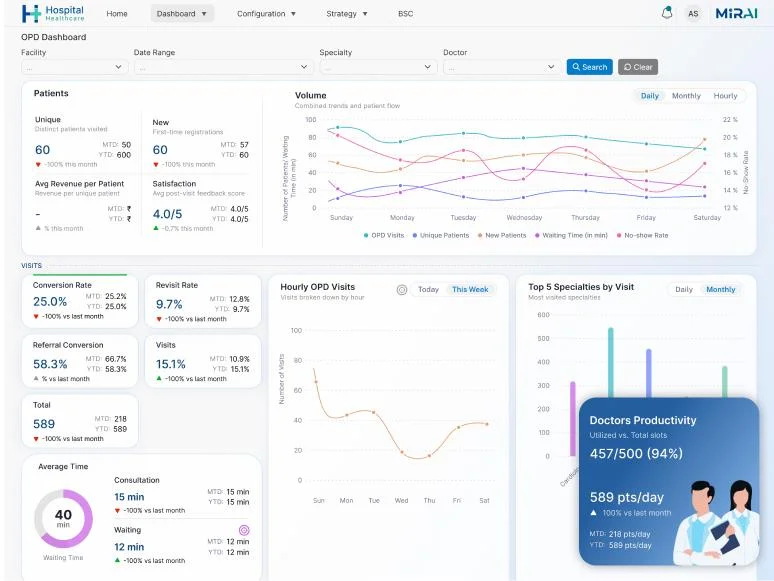
MIRAI is not a single dashboard — it is a comprehensive hospital intelligence system with specialized, drill-down dashboards for every operational area. Each dashboard contains department-specific KPIs with built-in benchmarks (JCI, NABH, WHO) and the 4-Pillar Strategy Module.


Built for Healthcare Leadership

Enterprise KPI Architecture
Every KPI in MIRAI is linked to a strategic objective, a BSC dimension, and a departmental owner. KPIs are not standalone numbers - they are part of a structured hierarchy that connects ward-level metrics to board-level goals. Each KPI includes calculation formulas, JCI/NABH benchmark values, regional benchmarks, and hospital-specific targets.

Strategy Execution Monitoring
MIRAI connects strategic objectives to measurable initiatives, task owners, and timelines. The 4-Pillar Strategy Module (People, Process, Technology, Infrastructure) ensures that every underperforming KPI has a structured remediation plan. Progress is tracked in real-time with completion percentages visible on the executive dashboard.

AI-Driven Decision Intelligence
MIRAI uses predictive analytics to identify trends before they become problems. AI-powered alerts notify leadership when a KPI is trending toward breach — not after it has already breached. Pattern recognition across departments identifies systemic issues that manual review would miss.

Executive Dashboards
Role-based dashboards designed for different leadership levels. The CEO sees a hospital-wide scorecard. The COO sees operational efficiency metrics. The CFO sees financial performance and risk exposure. The CMO sees clinical quality indicators. Each view is curated — no information overload.
Automated Board Reporting
MIRAI generates structured board reports automatically — including performance summaries, strategy execution status, risk registers, and financial highlights. No more manual PowerPoint preparation. Board packs are generated with one click, formatted to governance standards.
From Data to Decisions. From Dashboards to Discipline.
MIRAI transforms how hospital leadership operates:
Link Strategy to Measurable KPIs
Every strategic objective whether it is "Reduce ER wait time to under 10 minutes" or "Increase EBITDA margin to 22%" is connected to specific KPIs with ownership and timelines. Strategy is no longer a document that sits in a drawer.
Identify Deviations Early
Real-time monitoring means you see a KPI trending downward on Day 3, not Day 30. Early identification allows course correction before financial or clinical damage occurs.
Connect Performance with Risk
When OT utilization drops, MIRAI simultaneously shows the revenue impact and the risk exposure. Performance and risk are two sides of the same coin MIRAI treats them that way.
Enable Proactive Decision-Making
Replace reactive "firefighting" with structured, data-driven decisions. MIRAI provides not just the "what" (the KPI value) but the "why" (root cause analysis) and the "how" (strategy action plan).
Strengthen Board-Level Governance
Automated board reports, risk registers, and compliance dashboards ensure that governance is not a quarterly exercise but a continuous process. Board members get structured, consistent information not ad-hoc presentations.
MIRAI is Not a Dashboard Tool. It is an Executive Decision System.
Every hospital has dashboards. Most hospitals use Tableau, Power BI, or custom-built MIS reports. These tools are excellent at visualization but they stop at showing you the problem. They do not tell you what to do about it.
MIRAI is fundamentally different because it closes the loop:
01
Strategy
It starts with your hospital's strategic objectives and connects them to measurable KPIs.
02
Performance
It monitors those KPIs in real-time across every department.
03
Risk
It connects performance deviations to financial and clinical risk exposure.
04
Action
When a KPI underperforms, it deploys a structured, weighted action plan across People, Process, Technology, and Infrastructure.
05
Governance
It generates automated board reports that track strategy execution, not just financial results.
Without MIRAI, control is an illusion. With MIRAI, control is structured, measurable, and actionable.
MIRAI by the Numbers
200+
KPIs Tracked
Across clinical, financial, operational, and governance dimensions
15+
Specialized Dashboards
From OPD to Boardroom every department covered
4
Strategy Pillars
People, Process, Technology, Infrastructure actionable improvement plans
6
BSC Dimensions
Financial, Patient, Operational, Learning, Risk, ESG holistic performance view
10
Tasks per KPI
Every underperforming metric gets a 10-point evidence-based action plan
Real-Time
Data Refresh
No more 30-day-old reports decisions based on today's data